Annual Reports
DocuSign, Inc.'s annual reports contain management's most considered account of the business. These are the sections, passages and visual pages worth opening in the originals preserved in Sources.
Docusign, Inc. — FY2026 Annual Report (Form 10-K) — FY2026 (year ended January 31, 2026)
The latest 10-K: an 8%-growth e-signature franchise becoming an IAM platform, with IAM still 10.8% of ARR. · Open the full document →
Item 1. Business — Overview — p. 5 · Read the full section →
Management's own definition: a 98%-subscription franchise where IAM is the stated future but eSignature is still the engine.
The pricing model shifting from Envelope volume to user-based IAM tiers.
Historically, we offered access to most of our products on a subscription basis with prices based on the functionality and the quantity of Envelopes required by our customers. Similar to the physical envelopes historically used to mail paper documents, an Envelope is a digital container used to send one or more documents for signature or approval to one or more recipients. […] Our IAM subscription offerings have multiple pricing tiers as well as specialized packages for specific user personas, customer verticals and segments, and departments within an organization. While IAM subscriptions include our core products and solutions, like eSignature, we expect standalone eSignature to continue to represent the majority of our revenue for the foreseeable future given IAM’s early growth phase.
p. 5 · Read in context →
Item 1. Business — Our Growth and Investment Strategy — p. 7 · Read the full section →
The three pillars management is spending against: product innovation, omnichannel go-to-market, and operating efficiency.
Pillar one: R&D spend to turn IAM into a platform business.
We believe that our market opportunity is large, and we plan to invest to support long-term growth based on the three pillars of our long-term strategy: […] The first pillar is to accelerate product innovation through research and development investments, helping our IAM platform address our customers’ agreement management needs comprehensively. We aim to deliver category-leading value in the agreement management market while evolving into a platform company.
p. 7 · Read in context →
Pillars two and three: omnichannel GTM, efficiency, and the 13% international growth rate.
The second growth pillar focuses on improving our omnichannel go-to-market (“GTM”) capabilities to better meet the evolving needs of our customers. By strengthening our direct sales, partner, and self-service routes to market, we aim to simultaneously accelerate our ability to scale while reducing our customer acquisition and management costs. […] Finally, our third growth pillar is to enhance operational and financial efficiency to scale effectively and sustainably. This includes prioritizing investments in infrastructure and technology that best serve our diverse customer base, including our migration to cloud-based infrastructure. Additionally, we continue to evaluate strategic acquisitions and partnerships that align with our growth objectives and expand our product offerings. […] International revenue increased by 13% in the year ended January 31, 2026, compared to the year ended January 31, 2025.
p. 9 · Read in context →
Item 1A. Risk Factors — Business and Industry Risks — p. 23 · Read the full section →
Two company-specific risks: one product carries the revenue, and AI is making its core capability cheap to replicate.
Single-product concentration: eSignature is "the substantial majority" of revenue and demand has already fluctuated.
We derive a majority of our revenue from our eSignature product, and slower or declining adoption or sales of our eSignature product, without corresponding adoption or sales of our other products and solutions in our IAM platform, could cause our operating results to suffer. […] Sales of subscriptions to our eSignature product account for the substantial majority of our subscription and professional services revenue. Although we continue to add to our suite of other products and solutions in our IAM platform for automating the agreement process, we expect that we will be substantially dependent on our eSignature product to generate revenue for the foreseeable future. […] We have experienced, and may continue to experience, declines and fluctuations in the demand for our eSignature product due to a number of factors, including changing patterns of customer adoption and retention, shifts in customer spending levels, a highly competitive market, and general economic and global market conditions.
p. 23 · Read in context →
Item 1A. Risk Factors — Financial Risks, including Taxation — p. 43 · Read the full section →
Why reported revenue lags the business: long sales cycles feeding a ratable model that delays both downturns and inflections.
Item 7. MD&A — Executive Overview of Fiscal 2026 Results — p. 75 · Read the full section →
Management's framing of the year, plus a customer-count disclosure they will redefine on an ARR basis in fiscal 2027.
Customer base by segment — and notice that the definition changes next year.
As of January 31, 2026, we had a total of over 1.8 million customers, including approximately 280,000 small and medium-sized businesses (“SMBs”), mid-market companies, and large enterprise customers served by our direct sales force. We had a total of nearly 1.7 million customers, including over 260,000 customers served by our direct sales force as of January 31, 2025. […] In fiscal 2027, we plan to distinguish between enterprise, commercial mid-market and SMB customers on the basis of annual recurring revenue.
p. 76 · Read in context →
Item 7. MD&A — Discussion of Results of Operations — p. 82 · Read the full section →
The year in one table: 8% revenue growth, flat 79% gross margin, operating margin to 9% on restrained sales and marketing.
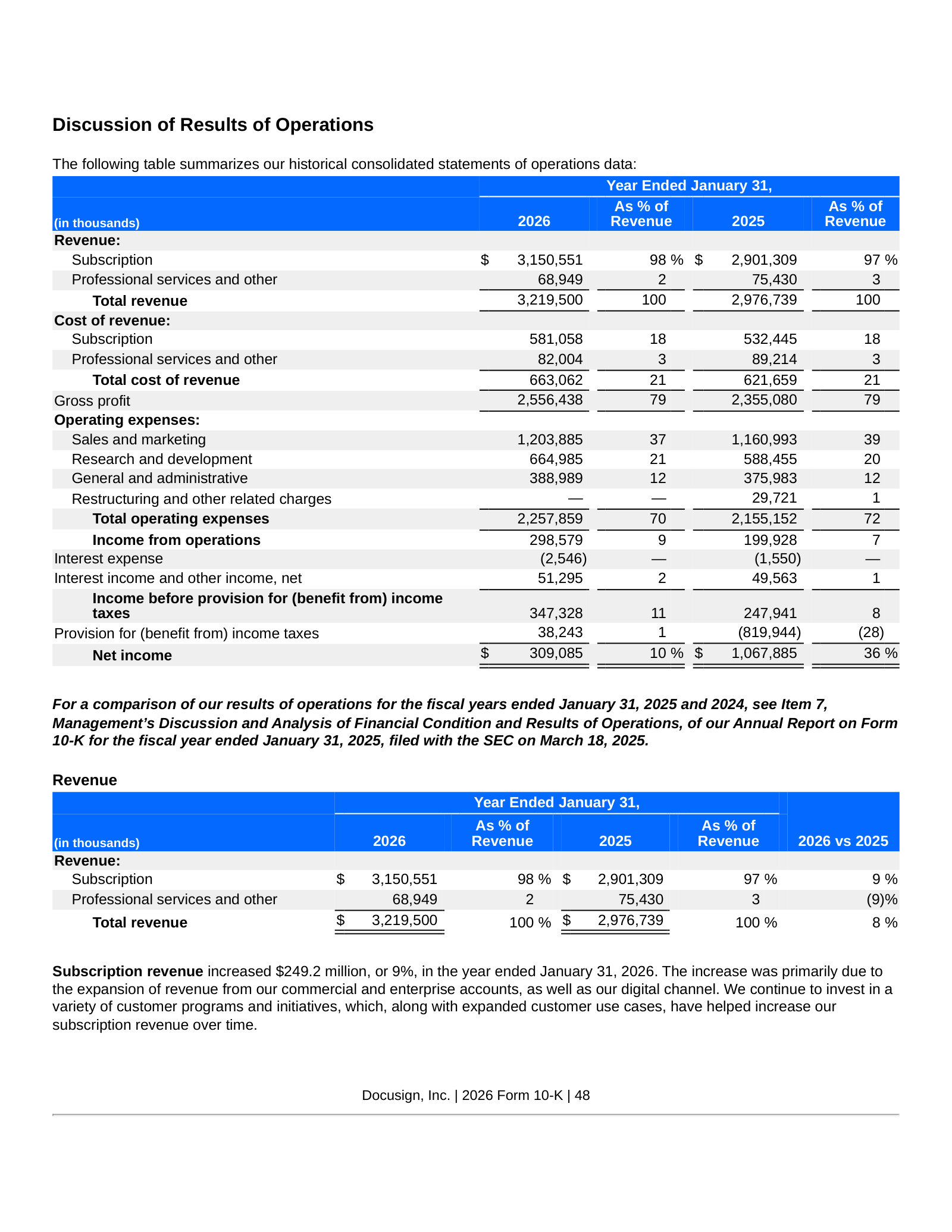
The spending mix: sales and marketing up 4%, R&D up 13%.
Sales and marketing expenses increased $42.9 million, or 4%, in the year ended January 31, 2026, primarily due to investments in our workforce. […] Research and development expenses increased $76.5 million, or 13%, in the year ended January 31, 2026, primarily due to investments in our workforce to support product innovation, including expansion due to our acquisition of Lexion in fiscal 2025.
p. 83 · Read in context →
Item 7. MD&A — Critical Accounting Policies and Estimates — p. 88 · Read the full section →
The estimate that defines subscription economics: how long commissions are capitalized, set by judgments on customer life.
Deferred contract acquisition costs — amortization period driven by estimated customer life.
The critical accounting estimates, assumptions and judgments that we believe to have the most significant impact on our consolidated financial statements are revenue recognition, deferred contract acquisition costs, stock-based compensation, income taxes, loss contingencies, and valuation of acquired intangible assets in business combinations. […] Contract acquisition costs are amortized on a straight-line basis over their period of benefit. […] The period of benefit for commissions paid for the acquisition of the initial subscription contract is determined by considering our customer life and the technological life of our software platform and related significant features. The period of benefit for commissions on renewal subscription contracts is determined by considering the weighted average contractual term for our renewal contracts. […] Any future changes in circumstances around our customer life and weighted average contractual terms of renewal contracts may materially change the periods of benefit and therefore the amortization amounts recognized in our consolidated statement of operations and comprehensive income.
p. 88 · Read in context →
Item 7. MD&A — Non-GAAP Financial Measures and Other Key Metrics — p. 92 · Read the full section →
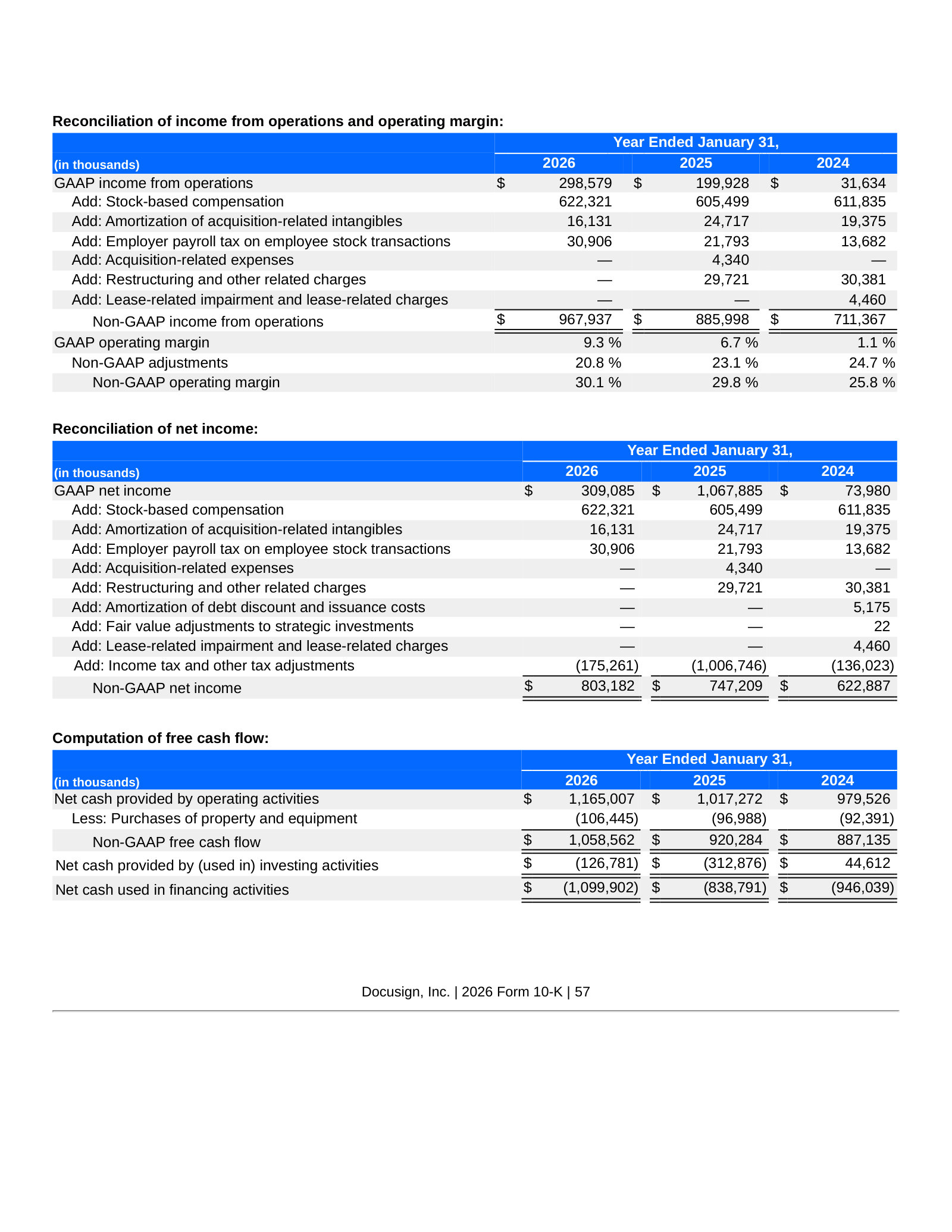
Where ARR and the GAAP-to-non-GAAP gap are defined — and where management retires billings after the first quarter of FY2027.
ARR of $3,272M and IAM's share of it: 10.8% versus 2.3% a year earlier.
ARR was $3,272 million as of January 31, 2026, $3,030 million as of January 31, 2025, and $2,805 million as of January 31, 2024. As of January 31, 2026, IAM represented 10.8% of our total ARR as of January 31, 2026, and 2.3% of our total ARR as of January 31, 2025.
p. 94 · Read in context →
DocuSign, Inc. — FY2024 Annual Report (Form 10-K) — FY2024 (year ended January 31, 2024)
The last 10-K before the April 2024 IAM launch — included as the before-picture of the strategy. · Open the full document →
Item 1. Business — Overview — p. 5 · Read the full section →
How the company described itself pre-IAM, including a $50 billion market claim the FY2026 filing no longer makes.
The pre-IAM framing, 1.5 million customers, and the $50 billion market estimate.
DocuSign offers products that address agreement workflows and digital transformation as part of its agreement management platform, enabling agreements to be signed electronically on a wide variety of devices, from virtually anywhere in the world, securely. […] As of January 31, 2024, over 1.5 million customers and more than a billion users in over 180 countries use our products and solutions to accelerate and simplify the process of doing business. […] The global reach and broad applicability of eSignature across business functions, combined with our offering of end-to-end contract lifecycle management applications represents an addressable market of approximately $50 billion, according to our estimates.
p. 5 · Read in context →
More annual reports
Docusign, Inc. — FY2025 Annual Report (Form 10-K) — FY2025 (year ended January 31, 2025) · 158 pages · First 10-K describing IAM as the platform strategy; also the $837.3 million valuation-allowance release year. · Open →
DocuSign, Inc. — FY2023 Annual Report (Form 10-K) — FY2023 (year ended January 31, 2023) · 162 pages · The post-pandemic reset edition: growth decelerating sharply, new leadership, and the first restructuring plan. · Open →
DocuSign, Inc. — FY2022 Annual Report (Form 10-K) — FY2022 (year ended January 31, 2022) · 166 pages · Peak COVID-era edition, when the business was framed as the DocuSign Agreement Cloud and growth ran above 40%. · Open →