Competitors
Competitors describe DocuSign, Inc.'s market in their own filings and calls. These verified passages and visual pages show where their strategies meet, using source documents preserved in Sources.
Adobe Inc. (ADBE)
Adobe is the largest direct rival to Docusign's core eSignature product. Acrobat Sign is not sold as a stand-alone signing service but bundled into Acrobat subscriptions, so the competitive question is whether signing gets absorbed into a document suite that already reaches hundreds of millions of users. Only Adobe's Acrobat / document-productivity (Business Professionals & Consumers) disclosure is used here; the Creative Cloud and Digital Experience businesses are outside the comparison.
The FY2025 10-K description of the same franchise a year later. Acrobat Sign no longer appears as a separately described principal solution; signing is folded into the Acrobat plan description as “subscribers can convert, edit, request signatures, and protect PDFs.” Read alongside the FY2024 language, this is Adobe presenting e-signature as a feature of a PDF subscription rather than a product line of its own.
Acrobat is our family of productivity solutions that allows users to consume, edit, sign, and create documents across platforms and surfaces, and better understand the information within them. Our Adobe Acrobat solutions are available on desktop, mobile, and the web with Acrobat Studio, Acrobat Pro, Acrobat Standard tiered plans, and for free with Adobe Acrobat Reader. […] Adobe Acrobat is our comprehensive PDF solution with a full set of tools to convert, edit, share and sign PDFs across various surfaces and platforms. Acrobat enables automated, collaborative workflows with a rich set of commenting, editing and sharing tools and direct integration with Adobe Acrobat Sign. With the Acrobat Standard plan, subscribers can convert, edit, request signatures, and protect PDFs. The Acrobat Pro plan offers additional advanced PDF features.
p. 6 · Read in context →
Adobe's reported scale for the customer group that contains Acrobat and Acrobat Sign, from the Q2 FY2026 call. The ‘Business Professionals & Consumers’ group is far broader than signing — it includes Acrobat, Express and Acrobat AI Assistant — and the 850 million MAU figure is free-and-paid usage across those apps, not signing customers. What it shows is the size of the installed base into which Adobe can distribute a signing feature.
Steven Day (Interim CFO & Senior Vice President, Corporate Finance): Business professionals and consumers subscription revenue was $1.85 billion increasing 16% year-over-year as reported or 15% in constant currency. Q2 growth drivers for Business Professionals and Consumers included sustained double-digit ending ARR year-over-year growth across all geographies. Acrobat and Express MAU surpassed 850 million growing approximately 20% yearover-year. Acrobat AI Assistant ARR growing approximately 3x year-over-year and strong performance in the enterprise across both commercial and government.
p. 6 · Read in context →
OneSpan Inc. (OSPN)
OneSpan is the closest thing in the peer set to a pure-play e-signature competitor: its Digital Agreements division sells OneSpan Sign into banks and other regulated enterprises, and its 10-K names Docusign as one of only two primary competitors in the category. Its management also argues explicitly against seat-based pricing — the model Docusign monetises on. Only the Digital Agreements commentary is used; the Cybersecurity/authentication division does not overlap with Docusign.
OneSpan's competition disclosure in its FY2025 Form 10-K. It defines the market it competes in as a single combined security/authentication/identity/e-signature/workflow market, flags AI-enabled low-cost software development as a source of intensifying competition, and names Docusign and Adobe as its two primary e-signature competitors while conceding both are significantly larger.
The market for digital solutions for security, authentication, identity, electronic signature, and digital workflow products is very competitive and, like most technology-driven markets, is subject to rapid change and constantly evolving solutions and services. Competition in our markets may intensify further as advances in AI enable rapid, low-cost development of software applications. […] Our primary competitors for electronic signature solutions are Docusign and Adobe Systems. Both companies are significantly larger than us. In addition to these companies, there are numerous smaller and regional or niche providers of electronic signing solutions.
p. 9 · Read in context →
OneSpan's stated read on the e-signature replacement cycle, from the market-trends section of the same 10-K. It characterises COVID-era e-signature deployments as siloed, hard to customise, costly to scale and in some cases a security risk, and argues buyers are now consolidating them on cost and total-cost-of-ownership grounds. This is a challenger's framing of the incumbent installed base and is offered as such, not as an established market fact.
At the same time, organizations are reassessing their e‑signature foundations. Many tools adopted rapidly during the COVID era were deployed in silos, offer limited customization, are costly to scale, and, in some cases, introduce additional security risks. As companies consolidate these fragmented deployments, they are prioritizing cost‑effective, enterprise‑wide solutions that support broad use‑case coverage and deliver a lower total cost of ownership.
p. 6 · Read in context →
OneSpan's CEO drawing an explicit contrast on pricing model in the Q1 FY2026 call: about 97% of its Digital Agreements business is priced on expected e-signature transactions or documents rather than on employee or user counts. The passage is an unprompted statement of positioning against seat-based licensing, which is how Docusign's eSignature business is largely sold.
Victor T. Limongelli (Chief Executive Officer): Last but not least, I want to reiterate that neither our digital agreements business nor our cybersecurity business has seat-based licensing as the primary revenue model. In cybersecurity, we sell to our customers based on the number of their end users and not based on the number of their employees or seats. Our licenses are tied to the number of consumers using strong authentication or app shielding solutions. Similarly, in digital agreements, the vast majority of our business, about 97%, is priced based on the number of expected e-signature transactions or documents rather than customer employee counts or user counts.
p. 2 · Read in context →
Box, Inc. (BOX)
Box competes with Docusign by bundling: Box Sign, Box Doc Gen and Box Apps are packaged inside its Enterprise Advanced plan alongside content management and AI, so signing arrives as part of a platform deal rather than as a separate purchase. Box's 10-K explicitly adds e-signature to the list of markets it now competes in, and its earnings calls describe displacing an e-signature vendor in a platform consolidation. Box's storage/file-sync business is outside the comparison.
How Box defines and sizes its market in the FY2025 Form 10-K — large, highly competitive and highly fragmented — and its statement that expanded product scope now puts it in competition with e-signature and workflow-automation companies. Box names Microsoft, OpenText, Google and Dropbox as specific competitors elsewhere on the page but does not name Docusign; the e-signature overlap is asserted at the category level.
The content management market is large, highly competitive and highly fragmented. It is subject to rapidly evolving technology, shifting customer needs and frequent introductions of new products and services. We face competition from a broad spectrum of technology providers: traditional content management vendors who deploy on-premise and offer deep records management, business process workflow, and archival capabilities; newer enterprise vendors who are beginning to enter the content collaboration market; vendors whose core competency is simple file sync and share, which can be deployed on-premises, hybrid, or via a SaaS delivery model; and social collaboration vendors who focus on the conversations that occur between teams. With our expanded produc offerings and use cases, we also now compete with companies in the e-signature, content collaboration, workflow automation, AI, and security and governance markets.
p. 12 · Read in context →
A displacement claim from Box's Q2 FY2026 call: a US law firm signing an enterprise-wide Enterprise Advanced agreement that Box says replaced both a cloud platform vendor and an e-signature company. Box does not name the displaced vendor, and this is a single anecdote offered as an adoption example rather than a quantified share shift — but it is the shape of competition Docusign faces from platform bundling.
Aaron Levie (Co-Founder and CEO): We had strong momentum in Q2 in customer adoption of Enterprise Advanced, which brings together our most powerful intelligent workflow capabilities in one plan. Examples include a prominent US law firm that became a new customer to Box, driven by Enterprise Advanced AI-powered metadata extraction capabilities and intelligent no-code apps to power its business processes. This is an enterprise-wide agreement replacing both an existing cloud-based platform vendor and an eSignature company.
p. 1 · Read in context →
Box's Q4 FY2026 update on the bundle that carries its signing product: Enterprise Advanced reached 10% of revenue in its first year. The customer example describes quote creation and approvals running on Box Doc Gen, Box Sign and Box Apps together — document generation plus signature plus workflow, the same combination Docusign sells as intelligent agreement management.
Aaron Levie (Co-Founder and CEO): Enterprise Advanced customers have reached 10% of revenue, and we're incredibly excited about this early traction and continued momentum. Examples of Enterprise Advanced customer wins include a leading biotech company uses Box to manage large volumes of commercial documents but currently relies on manual searches to find key information. By upgrading from Enterprise Plus to Enterprise Advanced, the company will use AI-powered data extraction and integrated apps to surface critical commercial data directly from documents. Next, a leading global robotics company uses Box as the core platform for its revenue operations and content workflows. The company upgraded from E Plus to Enterprise Advanced to streamline quote creation and approvals with Box Doc Gen, Box Sign and Box Apps to increase throughput and reduce errors.
p. 1 · Read in context →
GMO GlobalSign Holdings K.K. (3788)
GMO GlobalSign Holdings runs GMO Sign (電子印鑑GMOサイン), the electronic-contract service that competes with Docusign in Japan, alongside a certificate-authority business. It is the one peer here that publishes hard penetration and volume metrics for a national e-signature market, and it is simultaneously a supplier to Docusign — GlobalSign certificates sit underneath Docusign's signatures. Only the electronic certification / e-seal segment is used; GMO's hosting and other businesses are not.
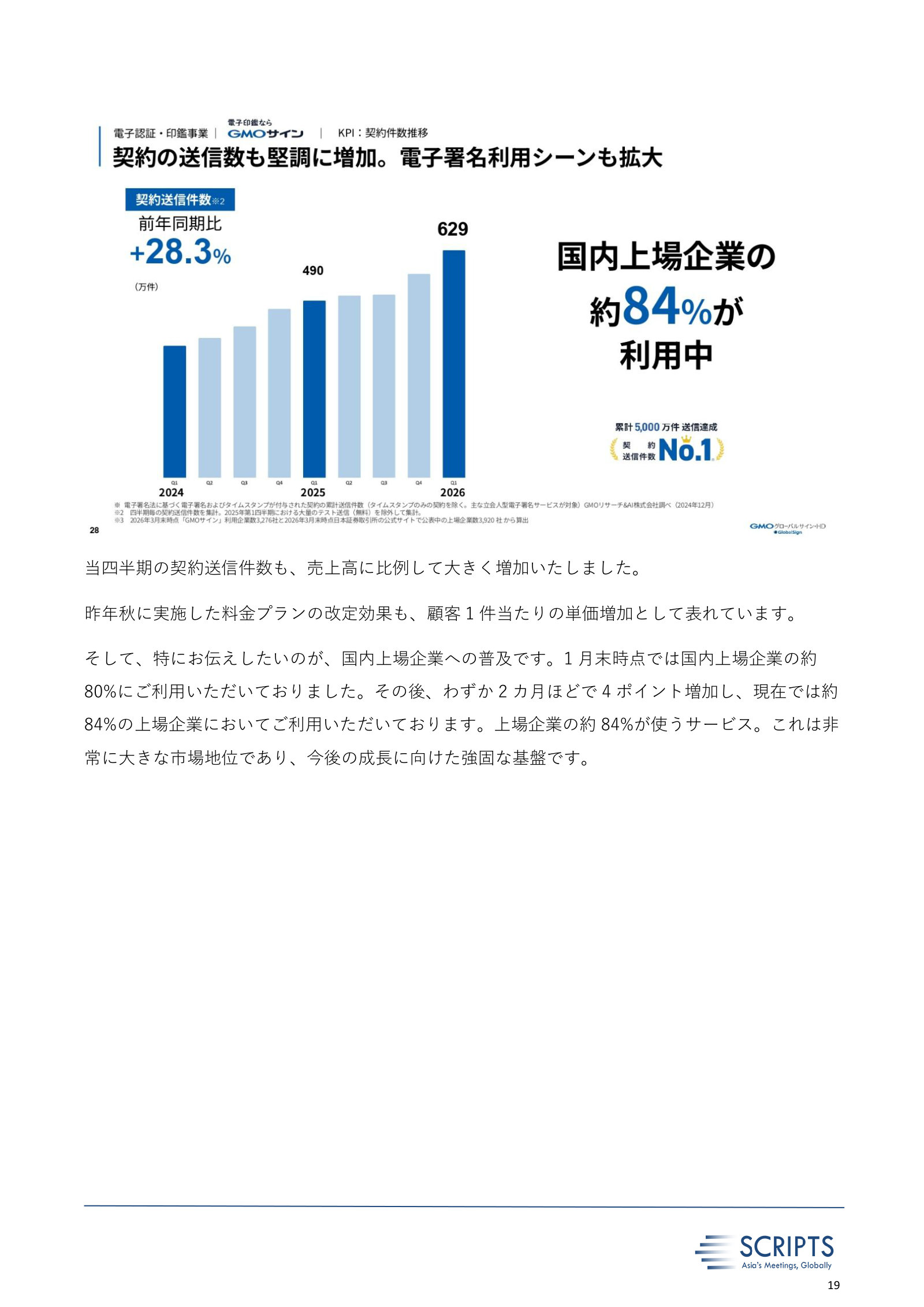
The revenue and ARR commentary from the facing page of the same Japanese-language deck. GMO Sign quarterly revenue of ¥584 million, up 28.7% year over year, with ARR growth held above 30%; the chart on the page puts ARR at ¥2,252 million, roughly US$15 million at current rates. Set against the 84% penetration claim on the next page, this is what that reach converts into — broad usage across Japanese listed companies at very low revenue per customer.
Mitsuru Aoyama (President and Representative Director): こちらはGMOサインの売上高およびARR、つまり年間定期収益の四半期推移です。当四半期の売上は前年同期比28.7%増の 5億 8,400万円となりました。ARRも 30%以上の成長を維持しております。
p. 19 · Read in context →
GMO naming Docusign in its Q3 FY2025 deck — as a customer, not a rival. Management states that its electronic signatures are adopted by ‘fast-growing electronic-contract providers Docusign and Adobe’ for their signing, and that signature volumes have grown 2.5x in five years to 5 million per month. The passage documents a supplier relationship running underneath a competitive one: GMO sells trust-service infrastructure to the same vendors GMO Sign competes with in Japan.
Mitsuru Aoyama (President and Representative Director): また当社が提供する電子署名については、海外では請求書や卒業証明書などにも多く使われておりますし、また急成長している電子契約事業者Docusignや Adobe社の署名にも採用されております。電子署名の数は5 年前と比べて 2.5倍の月間500万件と伸長しており、今後もさらに拡大するものと思われます。
p. 12 · Read in context →
Dropbox, Inc. (DBX)
Dropbox owns Dropbox Sign (the former HelloSign) and DocSend, and its 10-K names Docusign directly as an e-signature competitor. It is the clearest example in the peer set of a platform company that bought into e-signature and then chose to run it for cash rather than growth — useful as a read on how a scaled adjacent player values the category. The storage and Dash search businesses are outside the comparison.
Dropbox's competition section in its FY2025 Form 10-K. Docusign is named, but note the qualifier Dropbox itself applies: it competes in the e-signature market ‘on a more limited basis’, grouped with Box and Adobe, while its primary competitive framing is cloud storage and content collaboration against Microsoft, Google and Apple.
The market for content collaboration platforms is competitive and rapidly changing. Certain features of our platform compete in the cloud storage market with products offered by Microsoft, Amazon, Apple, Google, and Adobe and in the content collaboration market with products offered by Microsoft, Atlassian, Slack (now part of Salesforce) and Google. On a more limited basis, we compete with Box in the cloud storage market for deployments by large enterprises as well as in the e-signature market along with Adobe and DocuSign and in the AI content search market along with Glean, Guru and Notion. We also compete with smaller private companies that offer point solutions in the cloud storage market or the content collaboration market.
p. 13 · Read in context →
Dropbox's CEO separating its document-workflow assets by investment posture on the Q2 FY2025 call: continued investment in DocSend, while Sign and FormSwift are run ‘for maximum profitability.’ Management does not disclose e-signature revenue, so this is a statement of intent rather than a performance figure — but it indicates that one of the named e-signature competitors is harvesting the product rather than contesting the category.
Andrew W. Houston (CEO): Across our document workflow business, we continue to invest in DocSend, and we've improved document upload flows, processing speeds, and simplifying sharing and permissions. These improvements are resonating with customers, as DocSend continues to grow at a double-digit pace year-over-year. As mentioned previously, we remain focused on operating both Sign and FormSwift for maximum profitability, and both of these business lines continue to perform well against this objective.
p. 2 · Read in context →
eMudhra Limited (EMUDHRA)
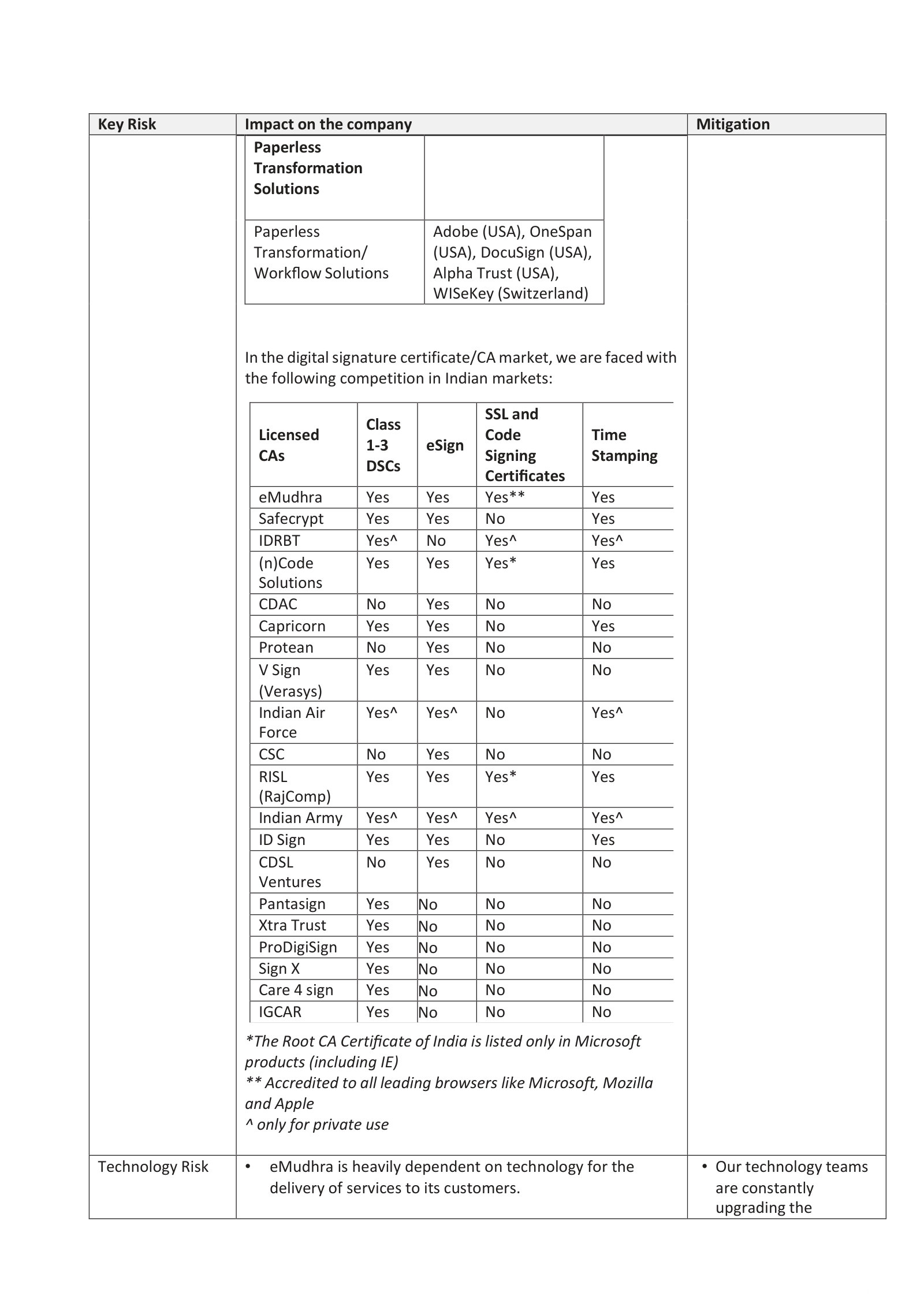
eMudhra is a certifying authority and paperless-transformation vendor in India, the Middle East and Africa, whose emSigner product competes with Docusign in markets where trust services and local certificate regulation matter. Its annual report names Docusign in its competitive landscape, and its calls quantify the volume-versus-price dynamics of e-signature in an emerging market — a different economic model from Docusign's envelope and seat pricing. Its cybersecurity and IT-services businesses are outside the comparison.
eMudhra's Executive Chairman on e-signature volumes in the Q2 FY2026 call: daily e-signature transactions up from 30,000–40,000 to roughly 300,000 (3 lakh), with an explicit acknowledgement that revenue per signature is low. The exchange is about eMudhra's trust-services line in India, and it illustrates the pricing level at which high-volume e-signature is transacted in that market.
Venkatraman Srinivasan (Executive Chairman): So mainly the growth this time has come more from the e-signature because e-signature is of the trust services. And a lot of earlier we were doing 30,000, 40,000 eSignature per day. Today, we are doing almost 3 lakh e-signature per day. But though the revenue per signature revenue is less, but some growth.
p. 11 · Read in context →
More peer documents
OneSpan — FY2024 Form 10-K — FY2024 · 105 pages · Pages 8 and 14 carry the prior-year wording of the same competition section naming DocuSign and Adobe — the comparison that shows whether OneSpan’s framing of the e-signature market has shifted. · Open →
OneSpan — Q4 FY2025 earnings call — Q4 FY2025 · 8 pages · Page 2 is the fullest statement of OneSpan’s Digital Agreements pitch — “industry-leading price-to-value”, gross retention improving past 90%, and an explicit build-versus-buy argument against enterprises replicating a signing platform. · Open →
Adobe — Q1 FY2026 earnings call — Q1 FY2026 · 13 pages · Pages 2, 5 and 11 lay out the Acrobat freemium funnel — 850 million MAU, the paywall mechanics management describes as “the first freemium funnel around software”, and the segment ARR behind it. · Open →
Box — Q3 FY2026 earnings call — Q3 FY2026 · 10 pages · Page 2 introduces Box Automate and Box Extract and states the ambition to “power any end-to-end document workflow” — the workflow layer above signing that Box is building. · Open →
Dropbox — FY2024 Form 10-K — FY2024 · 121 pages · Pages 13 and 20 give the prior-year competitor list naming Adobe and DocuSign, before the AI-content-search competitors were added — useful for tracking how Dropbox’s stated competitive set is drifting away from e-signature. · Open →
eMudhra — Q4 FY2026 earnings call — Q4 FY2026 · 12 pages · Page 4 gives the FY2027 plan: over 3 lakh daily e-sign transactions in Indian banking, e-signature rollouts across the Middle East and Africa, and emSigner targeted at the untapped India MSME and banking segments. · Open →
GMO GlobalSign Holdings — Q4 FY2025 results presentation — Q4 FY2025 · 30 pages · Pages 18–20 hold the full-year GMO Sign story — a stated domestic share No.1, 50 million cumulative sends, FY revenue of ¥1,997 million (+31.3%), and the plan-repricing move management credits for rising revenue per customer. · Open →